Every year, thousands of commercial businesses, industrial factories, and residential complexes suffer catastrophic losses due to uncontained fires. One of the primary reasons a small spark turns into an uncontrollable blaze is the lack of proper knowledge regarding the types of fire extinguishers and their uses. Installing a fire extinguisher is only the first step in compliance; deploying the correct class of extinguisher during an emergency is what actually saves lives and property.
For business owners, apartment builders, factory managers, and office administrators, understanding fire safety is not just a regulatory obligation it is a moral imperative. Using the wrong type of fire extinguisher on a specific fire can not only fail to extinguish the flames but can actually spread the fire faster or cause fatal electrocution.
In this comprehensive guide, we will explore the different classes of fires, detail the specific types of fire safety equipment required to combat them, and provide actionable insights for ensuring total fire safety compliance across your properties in Hyderabad and Telangana.
Why Understanding Fire Extinguisher Types is Crucial
Fires are fueled by different materials ranging from everyday paper and wood to highly volatile chemicals and live electrical currents. Because the chemical reaction that sustains a fire varies depending on the fuel source, the extinguishing agent must also vary.
For instance, spraying water on a grease fire in a commercial kitchen will cause the burning oil to splash and spread the fire explosively. Similarly, using a water-based extinguisher on an electrical panel in an IT office could result in a lethal electric shock to the user. By integrating the right Fire Safety Products into your building’s infrastructure, you minimize risk, protect your workforce, and ensure uninterrupted business operations.
The 5 Main Classes of Fire Explained
Before diving into the extinguishers themselves, we must define the internationally recognized classes of fires. The National Fire Protection Association (NFPA) categorizes fires into five main classes:
- Class A: Ordinary combustibles such as wood, paper, cloth, trash, and plastics.
- Class B: Flammable liquids and gases, including gasoline, petroleum oil, paint, propane, and butane.
- Class C: Energized electrical equipment like motors, transformers, servers, and appliances.
- Class D: Combustible metals such as magnesium, titanium, zirconium, sodium, lithium, and potassium (commonly found in industrial factories).
- Class K: Cooking oils and greases, typically involving animal or vegetable fats in commercial kitchens.
5 Common Types of Fire Extinguishers and Their Uses
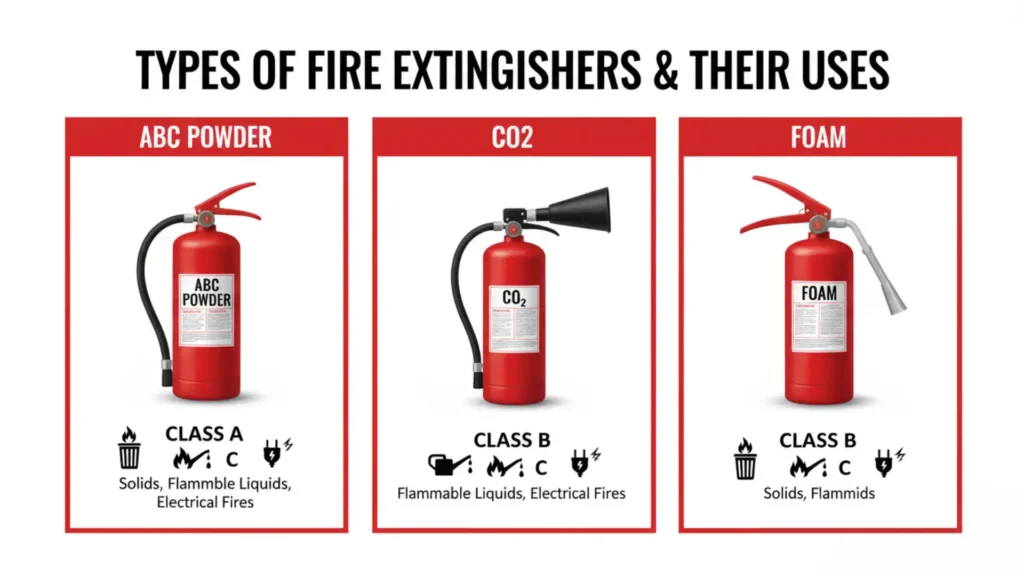
To combat these diverse fire classes, manufacturers have developed specific extinguishing agents. Here is an expert breakdown of the different types of fire extinguishers available today.
1. Water and Foam Fire Extinguishers
Water and foam extinguishers extinguish fires by taking away the heat element of the fire triangle. Foam agents also separate the oxygen element from the other elements.
- Best Used For: Class A fires (wood, paper, cloth). Foam can also be used on Class B (flammable liquids).
- Do NOT Use On: Class C (electrical) fires or Class K (kitchen grease) fires. Water conducts electricity and will spread flammable liquids.
- Identification: Typically feature a solid red label (Water) or a cream label (Foam).
- Common Locations: Office corridors, schools, warehouses storing dry goods.
2. Carbon Dioxide (CO2) Extinguishers
Carbon Dioxide extinguishers work by removing the oxygen element from the fire triangle and removing the heat with a very cold discharge.
- Best Used For: Class B and Class C fires. They leave no residue behind, making them ideal for areas with sensitive electronics.
- Do NOT Use On: Class A fires (it may not successfully extinguish the fire, and it could reignite) or in confined spaces without proper ventilation, as CO2 displaces oxygen.
- Identification: Features a black label and a distinct hard horn rather than a flexible hose.
- Common Locations: Server rooms, laboratories, and IT parks in tech hubs like Madhapur and Hitech City.
3. Dry Chemical (ABC Powder) Extinguishers
Often referred to as multi-purpose extinguishers, ABC powder extinguishers interrupt the chemical reaction of the fire.
- Best Used For: Class A, B, and C fires. This versatility makes them the most common fire safety equipment found in commercial buildings.
- Do NOT Use On: Class K fires or fires involving sensitive electronic equipment, as the fine powder leaves a corrosive residue that is difficult to clean and can ruin circuit boards.
- Identification: Features a blue label.
- Common Locations: Apartment hallways, retail showrooms in Dilsukhnagar, and manufacturing plants in Kukatpally.
4. Wet Chemical Extinguishers
Wet chemical extinguishers remove the heat of the fire triangle and prevent re-ignition by creating a barrier between the oxygen and fuel elements (a process called saponification).
- Best Used For: Class K fires involving cooking media (fats, grease, and oils).
- Do NOT Use On: Class C (electrical) or Class B (flammable liquid) fires.
- Identification: Features a yellow label.
- Common Locations: Commercial restaurant kitchens, food courts, and hotel galleys.
5. Clean Agent / Halogenated Extinguishers
Clean agents include halocarbon agents that extinguish fires by interrupting the chemical reaction and removing heat. They are non-conductive and leave no residue.
- Best Used For: Class B and C fires, and sometimes Class A fires. They are highly specialized for protecting irreplaceable assets.
- Identification: Typically feature a green label.
- Common Locations: Data centers in Gachibowli, museums, archives, and medical imaging facilities.
Selecting the Right Extinguisher for Your Hyderabad Business
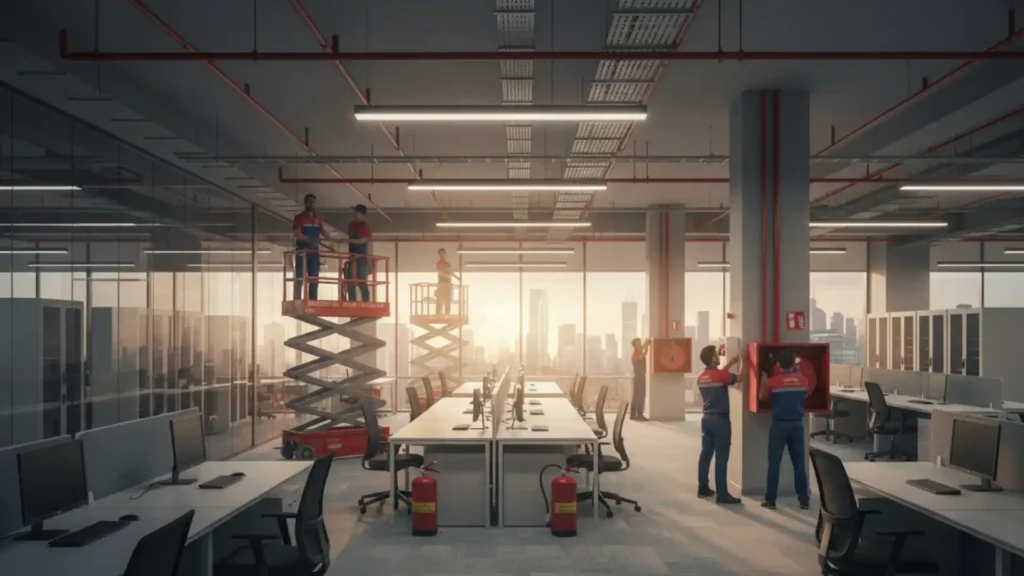
When deploying Fire Safety Services for your commercial space, a “one-size-fits-all” approach will not suffice. You must conduct a thorough risk assessment based on your facility’s specific operations.
- Corporate Offices & IT Hubs: If you manage a software park in Hitech City or Gachibowli, prioritize CO2 and Clean Agent extinguishers for server rooms to prevent equipment damage, alongside standard ABC extinguishers for common areas.
- Industrial & Manufacturing: Factories in Kukatpally or Balanagar dealing with chemicals require a heavy presence of Dry Chemical and specialized Class D extinguishers for combustible metals.
- Retail & Residential: For shopping malls in Dilsukhnagar or large apartment complexes near LB Nagar, multi-purpose ABC powder extinguishers strategically placed on every floor are standard protocol.
Placement, Usage, and Maintenance Guidelines
According to guidelines established by the Occupational Safety and Health Administration (OSHA), simply owning an extinguisher is not enough. It must be accessible, functional, and your staff must know how to use it.
The P.A.S.S. Method
Train your employees and building residents to remember the P.A.S.S. technique during an emergency:
- Pull the pin on the extinguisher.
- Aim the hose or nozzle low, pointing at the base of the fire.
- Squeeze the handle to release the extinguishing agent.
- Sweep the nozzle from side to side until the fire is completely out.
Routine Maintenance
Fire safety equipment requires regular auditing:
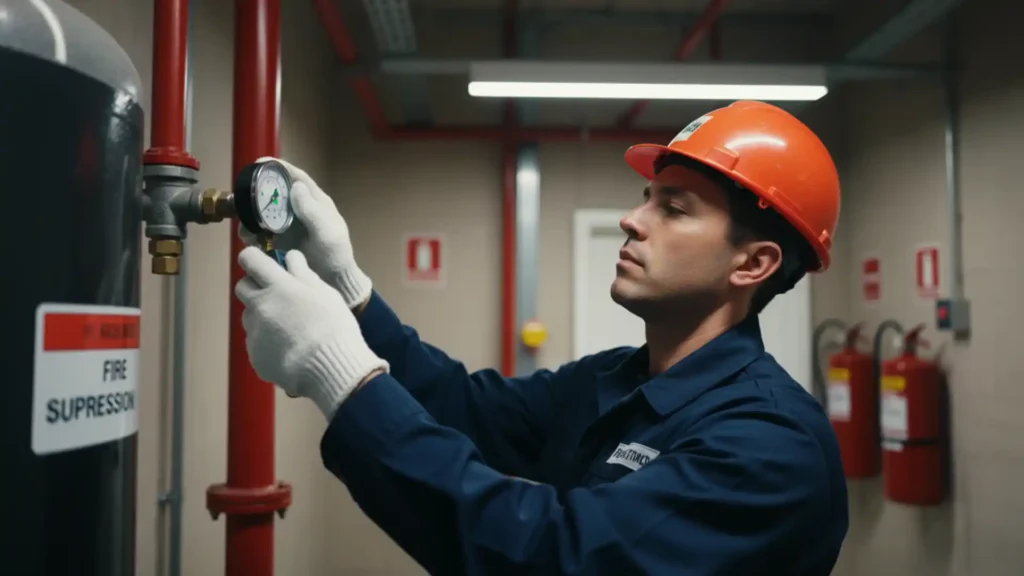
- Monthly Visual Inspections: Ensure the extinguisher is in its designated spot, not blocked by furniture, and that the pressure gauge needle is in the green zone.
- Annual Professional Servicing: A certified fire safety agency must inspect the physical integrity of the cylinder and the mechanics of the valve.
- Hydrostatic Testing: Depending on the extinguisher type, cylinders must undergo pressure testing every 5 to 12 years to ensure they are safe to use.
Fire Safety Compliance in Telangana
Navigating the legal landscape of fire safety is critical for business continuity. In Telangana, the State Disaster Response and Fire Services Department mandates stringent regulations for commercial buildings, high-rise apartments, and industrial units.
To obtain your initial occupancy certificate and your ongoing Fire No Objection Certificate (NOC), you must prove that your facility is equipped with the correct types of fire extinguishers, fire alarms, and sprinkler systems. Partnering with a professional firm ensures your building passes these inspections without costly delays. Learn more about securing your Fire Safety Permissions with certified experts.
Frequently Asked Questions (FAQs)
What is the most common type of fire extinguisher for commercial offices?
The Dry Chemical (ABC Powder) fire extinguisher is the most common for commercial offices. It is highly versatile and capable of putting out fires involving ordinary combustibles, flammable liquids, and live electrical equipment. However, CO2 extinguishers are heavily recommended for server rooms.
Can I use a water extinguisher on an electrical fire?
No. You must never use a water or foam fire extinguisher on an electrical fire (Class C). Water conducts electricity, which can lead to severe or fatal electric shock. Always use a CO2, Dry Chemical, or Clean Agent extinguisher for electrical blazes.
How often should fire extinguishers be serviced in Hyderabad?
In compliance with local and national safety standards, fire extinguishers must undergo a visual inspection monthly by building staff and a thorough professional inspection annually by a certified fire safety service provider.
What type of extinguisher is required for a commercial restaurant kitchen?
Commercial kitchens require Wet Chemical fire extinguishers (Class K). These extinguishers contain a potassium acetate-based agent that reacts with hot cooking oils and fats to create a soapy foam, cooling the fire and preventing reignition.
Conclusion
Understanding the types of fire extinguishers and their uses is foundational to protecting your property, your employees, and your business investments. From deploying CO2 systems in Gachibowli data centers to installing Wet Chemical extinguishers in bustling commercial kitchens, matching the right extinguishing agent to the specific fire hazard is non-negotiable.
Do not wait for a disaster to test your building’s fire readiness. Evaluate your current fire safety equipment, ensure routine maintenance is up to date, and stay compliant with Telangana’s rigorous fire safety regulations.
Secure Your Business with Professional Fire Safety Solutions
Are you unsure if your commercial building has the correct fire extinguishers? Ensure absolute safety and zero compliance issues with Divagni. We provide end-to-end fire safety equipment installation, maintenance, and NOC permission services across Hyderabad and Telangana.
- 🏢 Company: Divagni
- 📍 Location: LB Nagar, Hyderabad (Serving all of Hyderabad & Telangana)
- 📞 Phone: +91 98853 43437
- ✉️ Email: info@divagni.in